From educational experiences to nature adventures, there are so many things to do in southern Maryland for locals and tourists alike.
Below is our top 10 list — and there’s something in it for everyone.
1. VISIT HISTORIC ST. MARY’S CITY
St. Mary’s City was once recognized as the capital of the state. In 1633, England colonists set out from the Isle of Wight on the Ark and Dove, landing at the Old Point Comfort where they established their colony — St. Mary’s City.
Today, you can learn all about the history of this attraction while exploring historic ships up close, participating in colonial-style games, and learning about what farming was like during the 17th century.
Be sure there’s enough time to check out the brick chapel and archeological excavations as well.
2. TOUR THE CALVERT MARINE MUSEUM
The Calvert Marine Museum is located in Solomons, and it’s a must for anyone wanting to learn about the maritime history of the Chesapeake Bay area. The museum itself is filled with plenty of engaging and interactive exhibits, including the locally renowned river otter showcase.
There’s even a Marsh Walk and on-site Wood Carving Shop.
3. EXPLORE WINERIES ALONG THE PATUXENT TRAIL
The Patuxent Trail is a pastoral roadway that’s flanked by incredible water views — and you can lazily stroll it with your choice of red or white in hand.
The wineries along this trail offer full-bodied wines rivaling that of Napa Valley or even Tuscany. All you have to do is put your walking shoes on and pick which end of the trail you’d like to start with.
The warm, blowing April winds only mean one thing in southern Maryland: It’s baseball season!
Watching the Southern Maryland Blue Crabs play is always a great time. They play at least 70 home games throughout the season — held at the Regency Furniture Stadium — which means you can catch a game anytime between April and September.
Bonus points if you have young children that like to read. There are several local educators in Southern Maryland that offer “Reading Bookmarks” where children can redeem points for a complimentary game ticket simply for meeting certain literary milestones.
5. ENJOY JEFFERSON PATTERSON PARK
If you’re a lover of sunsets then it’s essential that you spend some time in Jefferson Patterson Park. The park is situated right on the Patuxent River, and it’s home to some of the most beautiful sunsets you’ve ever seen.
Of course, there’s plenty of time to explore before the sun sets, which means you’ll want to visit the Native American Village Museum, hike the trails, rent kayaks or paddle boards for St. Leonard Creek, and much more.
6. GET YOUR THRILLS AT THE MARYLAND INTERNATIONAL RACEWAY
Located in the aptly named Mechanicsville, the Maryland International Raceway is where you want to be for exciting car shows, “showdown battles,” biker fests, and anything else that has to do with loud engines and fast cars.
You can easily find the raceway’s jam-packed events schedule online to see what your options are. Just don’t forget to bring earplugs!
7. TRACE A HISTORICAL ASSASSIN’S ESCAPE ROUTE
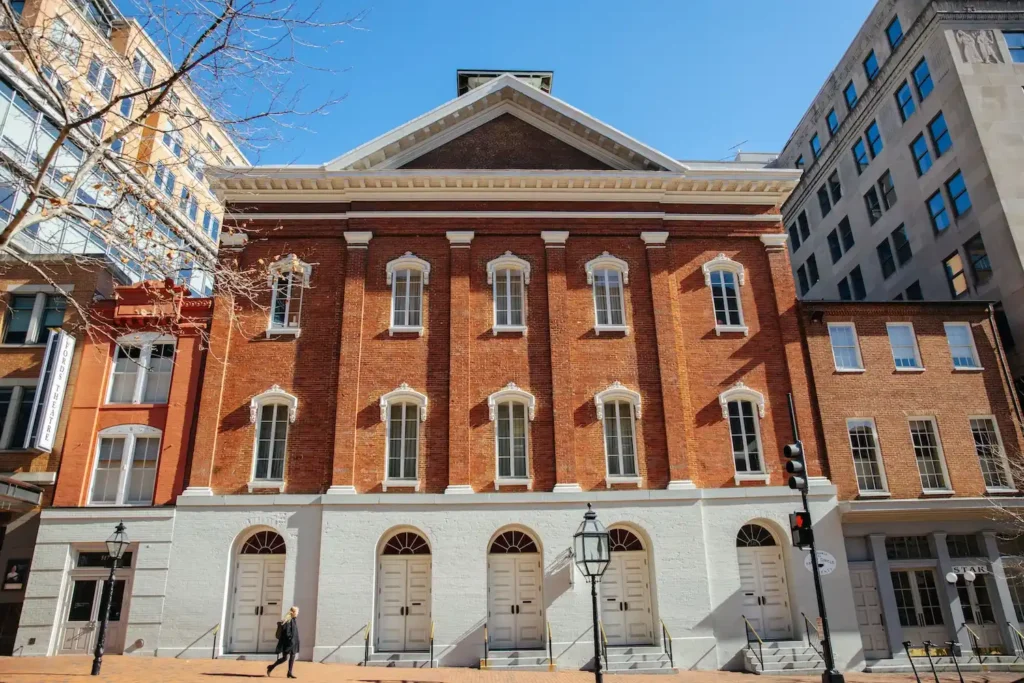
Right after the assassination of President Abraham Lincoln, Jon Wilkes Booth made his escape on a daring route that took him from the Ford Theatre in Washington City deep in Southern Maryland.
He wasn’t alone and the escape lasted a total of 12 days, and one of the most prominent destinations along this route is the Dr. Samuel Mudd House (now a museum). This is where he and his accomplice met Dr. Mudd, who tended to Booth’s injuries and allowed the two men to rest before continuing on.
We won’t spoil the rest of the story for you as you can get up close and personal via the local tours available through the Surratt Society.
8. ENJOY ANNMARIE SCULPTURE GARDEN AND ARTS CENTER
The Annmarie Sculpture Garden and Arts Center is a 30-acre property that’s home to some breathtaking meadows, forests, and wide-open fields. There are also plenty of paved walking and bike trails that allow you to marvel at unique outdoor sculptures.
There are also notable “Look Out” exhibits that will really make you stop and think for a minute.
9. TOUR THE POINT LOOKOUT LIGHTHOUSE
One of the most scenic areas in Southern Maryland is where the Potomac River meets the Chesapeake Bay. This is where you’ll encounter the Point Lookout State Park, which was once a Union outpost during the Civil War.
Here you can relax and swim at the beautiful beaches, visit the Point Lookout Lighthouse, fish off the pier, and take part in one of the park’s many outdoor activities — including rock climbing, cross-country skiing, biking, hiking, and more.
There are even campsites and lodges throughout the park if you’re looking to make a weekend trip out of it!
10. LEARN ABOUT AVIATION HISTORY
The Patuxent River Naval Air Station Museum, located in Lexington Park, is a great place for the whole family. The museum is filled with historic details on the region’s naval aviation and visitors can get up close and personal with historic artifacts as well as photographs, films, memorabilia, and more.
There’s also an intrinsic focus on the future as many exhibits feature research’s ongoing efforts and research in the field of aviation research, testing, development, and evaluation. But the real star of the show is the towering naval aircraft on display as well as a realistic F-14 Tomcat flight simulator. (Yes, you can try it out for yourself!)
PLAN A STAYCATION IN SOUTHERN MARYLAND
With so many things to do in Southern Maryland, you’ll want to make a weekend out of it — or even take an entire week to enjoy it thoroughly.
Of course, while you’re taking some much-needed time off to enjoy the local attractions, we can take care of your next home improvement project!
From inspection to completion, we’ll make sure the job gets done with care and experienced craftsmanship. What’s more, most home projects can be completed in just one day — although, we would still encourage you to take some extra time off to enjoy yourself.
If you have a roof leak, you’re not alone. A quick search on the internet will reveal that millions of people experience this problem every year. The good news is that there are several quick and easy ways to fix a leaky roof— temporarily, at least. Some common causes of roof leaks include:
Hail damage
Improper ventilation or insulation
Wind damage
Failed DIY repairs (oops!)
Wear and tear
In this guide, we’ll discuss some of the most common methods for fixing a roof leak. We will also provide some tips for preventing future leaks and why you should rely on the professionals to fix it for good.
WHAT YOU’LL NEED TO FIND AND FIX A ROOF LEAK 💦
In order to both find and fix a roof leak, there are some vital tools you’ll need first. Some you may have lying around the house, and the rest you should be able to pick up at your local hardware store for pretty cheap.
Bucket
Camera (or smartphone)
Flashlight
Garden hose
Ladder
Replacement shingles
Roofing caulk
Roofing nails
Roof patch
Work boots or non-slip shoes
Once you have all of your supplies, grab a friend— it’s time to get to work. We never recommend working alone, and for safety reasons, you should always have a buddy. Whether they are simply holding the ladder still or are just there for support should anything happen, never go it alone.
1) ROOF LEAK SIGNS TO LOOK FOR 👀
There are some obvious (and not-so-obvious) signs of roof leaks to look for. As you do a walk around your property, check for these tell-tale signs of a potential roof leak.
MISSING OR WARPED SHINGLES
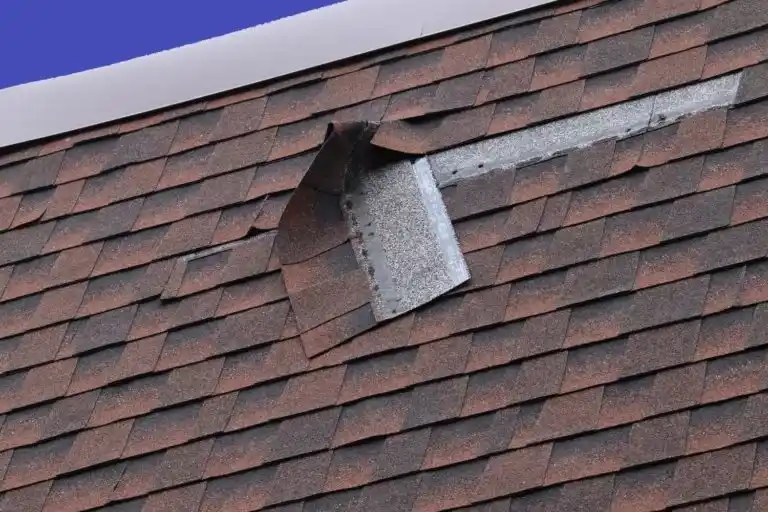
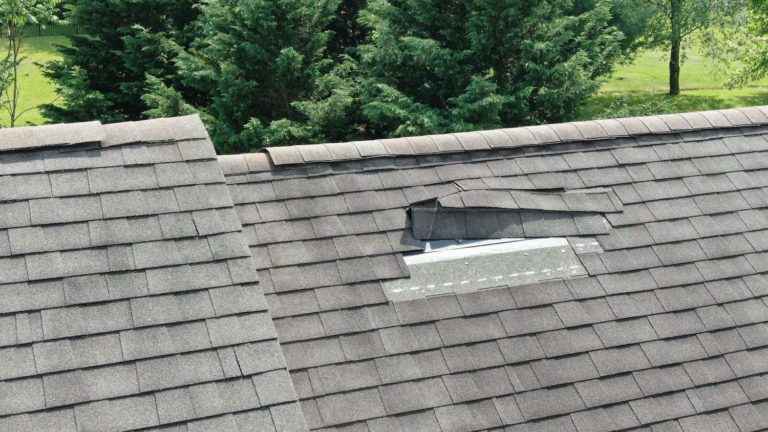
If you notice any shingles that are buckling, curling, missing, or warped, this is a sign of potential roof damage and leaks. A strong wind storm can easily blow off shingles or bend them enough to cause a gap in their seal, causing a water leak. This might be the most obvious sign of a roof leak and allows you to act even faster to get it repaired.
CRACKED OR DENTED SHINGLES
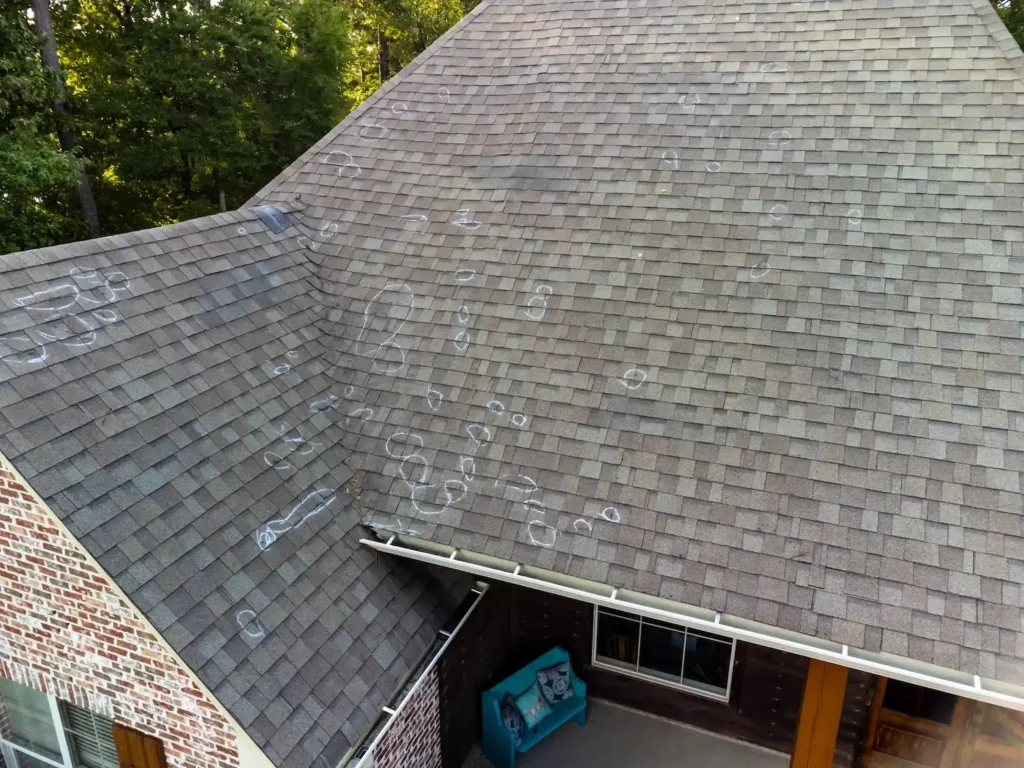
In addition to warped or missing shingles, you should also look for any cracks or dents. These can also be caused by severe weather conditions— particularly hail— and can result in water seeping through the roof and into your home.
LOSS OF SHINGLE GRANULES
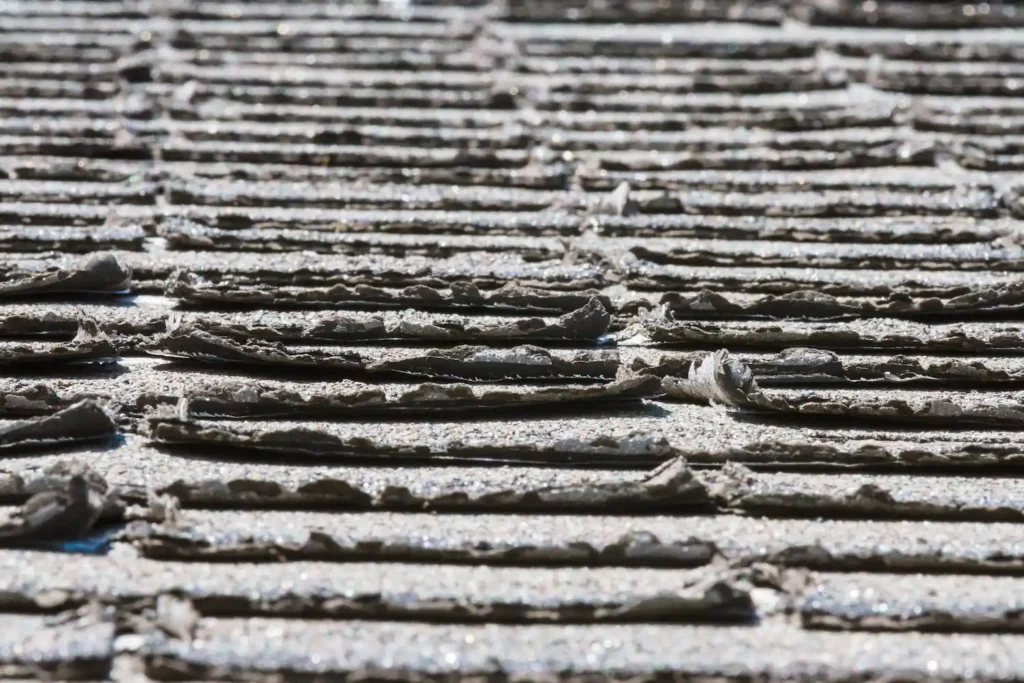
Asphalt shingles have a protective top layer of granules that help protect them from the elements and constant UV rays. Hail and debris can impact your shingles, causing these granules to come off.
This leaves the underlayers of your shingles exposed to the elements, which can allow further deterioration or water leaks. You may notice granule loss as discoloration on your shingles or you might find them in your gutters and downspouts after they’ve been flushed through.
MISSING OR CRACKED FLASHING
The flashing on your roof is intended to keep any areas where the roof meets a wall or roofing penetration like chimneys and vents from leaking. Flashing is also very exposed to the elements and is often one of the first things needing to be replaced on your roof. If it gets cracked or blown off during a storm, your roof becomes almost immediately susceptible to leaks along those vulnerable spots.
LARGE BRANCHES AND DEBRIS ON THE ROOF
If you have any large branches or debris that has fallen on your roof, this can damage your shingles and cause leaks. If a branch has pierced the roof itself, it’s important to get it removed as soon as possible to prevent further structural damage.
While these are some of the most common signs of potential roof leaks, keep in mind that not all leaks will be immediately obvious. If you’re unsure whether or not your roof is leaking, it’s always best to call in a professional for an inspection.
You can also notice signs of a roof leak inside your home— in the attic, upper floor rooms, or near chimneys and plumbing pipes. If you notice any of these roof leak signs inside your home, you should call a roofer right away as these leaks have either been growing for months, or are big enough to cause immediate damage to your home’s interior.
WATER STAINS ON THE CEILING OR WALLS
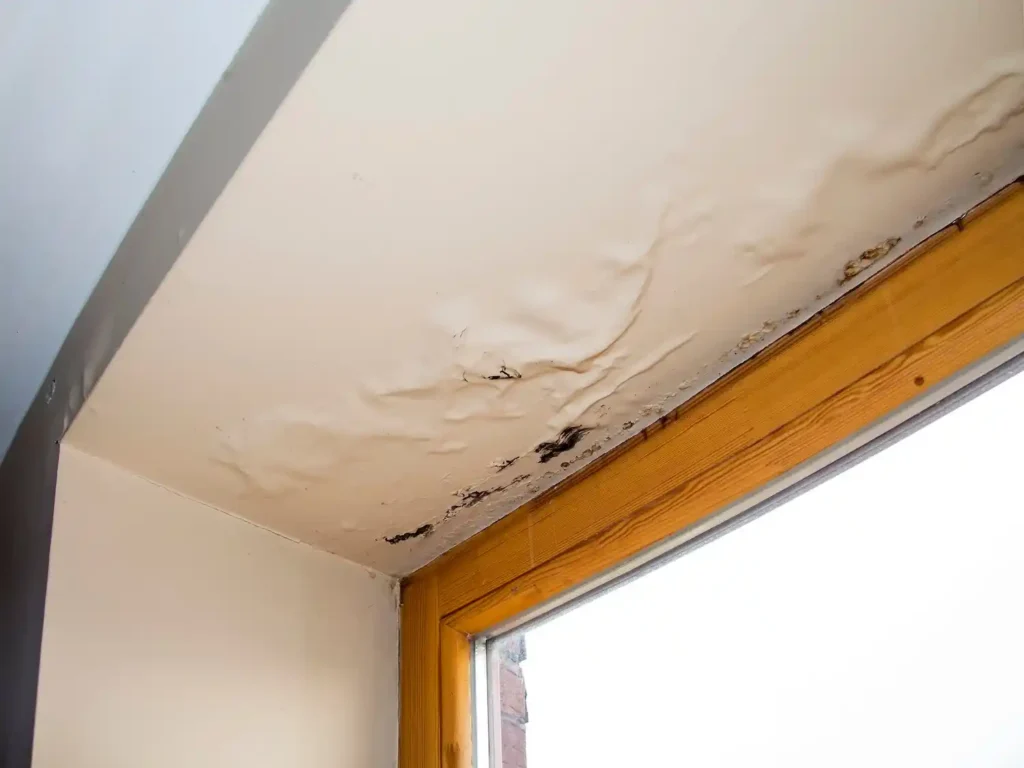
If you notice any water stains on your ceilings or walls, this is a sign that water has already made its way into your home and is coming from the roof. These stains will usually be darker near the edge of the stain and lighten in color as they dry. Water stains are often accompanied by peeling paint or wallpaper, which is another sign that you have a roof leak.
SAGGING CEILING TILES
Some homes don’t have a standard drywall ceiling, but rather ceiling tiles that fit together as a unique feature on the ceiling. If your ceiling tiles are sagging or beginning to fall, this is a sign of water damage and potential leaks from the roof. This is especially true if the tile is discolored or warped in any way.
MUSTY SMELL IN THE ATTIC
If your attic smells musty, it’s likely there is mold or mildew growth from a roof leak or from trapped moisture. A poorly ventilated attic can cause this, but roof leaks also can— so be sure to investigate more thoroughly.
BULGING INTERIOR WALLS
If you notice any spots or warping on your interior walls, this is a sign that water may have already made its way into your home. Check for any stains, discoloration, or bubbling paint as these can all be indicative of water damage.
HIGHER-THAN-NORMAL ENERGY BILLS
If you’ve noticed a sudden spike in your energy bills with no change in your energy usage, this could be caused by a hole or crack in your roof that’s letting heat escape. Not only will this lead to higher energy bills, but it can also let water and cold air into your home, which can cause further damage.
3) SIMULATE RAIN TO FIND HIDDEN LEAKS ☔
If you’re seeing potential signs of a leak but can’t pinpoint it to patch it, you can simulate rain by running a hose on your roof and having a buddy inside the attic watch for any interior drips. This can speed up the process of fixing your leak fast but does risk causing more damage if you run the water for too long. To safely try this technique you should:
Have a few people help.
Use very grippy shoes or boots to ensure you don’t slip on a wet roof.
Place the hose at the roof’s ridge and let it flow down like rain.
Check your gutters for leaks while you’re at it by running water through them.
If your friend helping you does see a drip in the attic, you can examine that specific section of shingles more closely. Look for things like:
Cracked or missing shingles
Water stains or pooling water
Rotting wood beams
Loose or missing nails (shingles will lift easily)
Loose flashing, vents, or plumbing boots
4) IF YOU’RE UP FOR THE CHALLENGE, MAKE THESE REPAIRS 🧰
If you’ve found the source of your leak (yes!) and feel confident making repairs yourself, here are some quick fixes you can do to patch up your roof until a professional can take a look:
Use duct tape or heavy-duty tarps to cover small holes or cracks: Stopping the water leak in its tracks is the best way to mitigate further damage while you wait to repair or patch the hole. For smaller holes, you can buy pre-made flashing patches that are very DIY-friendly.
For widespread damage, use a piece of plywood to cover the hole in addition to a heavy-duty tarp. Nail or screw the tarp into the plywood, but be sure not to puncture your roofing material. If you’re using multiple tarps, overlap them by at least six inches.
Replace any damaged shingles you find: If it’s a leak caused by a faulty shingle, get rid of the nails and scrap away the old roofing cement. Then apply fresh cement to the area and nail the new shingle overtop. (If you have many damaged shingles, leave this one to a professional.)
Reapply roofing caulk or flashing: You may see a leak coming from vents, chimneys, or window edges. In these areas, attempt to replace the caulk around the flashing. New caulk will help fill any gaps and new flashing will immediately secure that portion of your roof against leaks.
Fix plumbing boots or roof vents: The base of your chimney or plumbing pipes come out through the roof and are covered with a rubber “boot.” Over time, these can crack and cause leaks. You can temporarily fix this by slipping a piece of metal flashing under the boot and nailing it in place (again, best done by a professional).
5) GET A PROFESSIONAL ROOF INSPECTION 🕵️
If you don’t feel confident making repairs yourself, or if the damage is widespread, your best bet is to call a professional roofing contractor. They will be able to quickly assess the situation and provide you with options for moving forward.
A quick fix for a roof leak may seem like an easy solution, but it’s important to remember that these are only temporary. The best way to fix a roof leak is to get a professional inspection and, if necessary, complete repairs as soon as possible. Ignoring the problem will only cause more damage in the long run. Contact a roofing contractor today for more information.
SKIP THE DIY AND HIRE MARS RESTORATION
We love a homeowner who embraces DIY fixes and projects around the house— but when it comes to your roof, we always recommend hiring a professional. Failed repairs can not only make problems worse, but can void warranties and deny insurance claims. So why not work with a roofer who knows what they’re doing, instead?
At MARS Roofing, we can inspect, diagnose, and repair your roof before you can say, “I’ll fix it.” Trust us, working with a reputable contractor to fix your roof is worth it. Call us today!
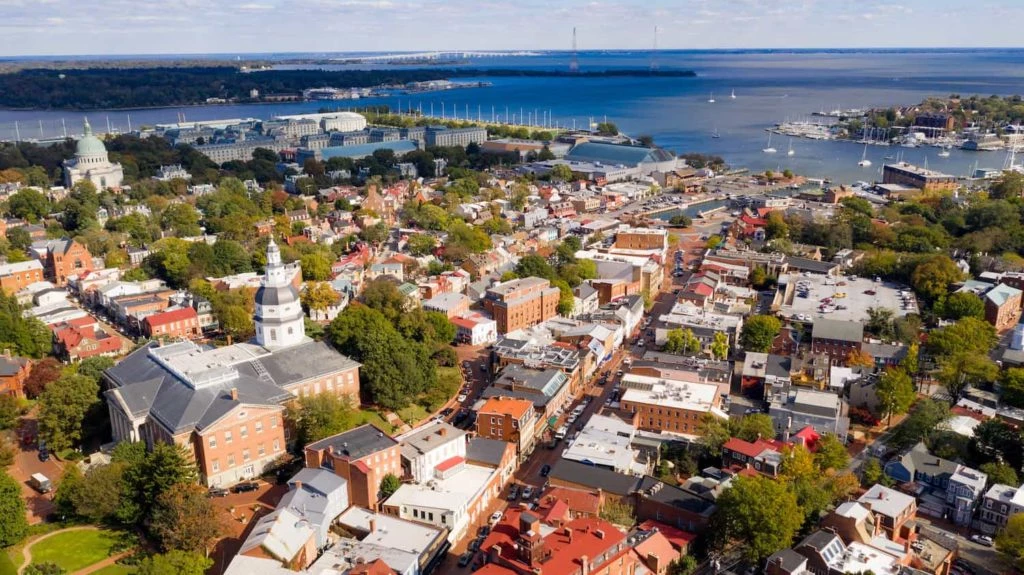
MARS Roofing has been serving the Southern Maryland area for over 30 years, and we may be biased, but this place is the best. From museums to parks to historical landmarks, there are so many fun things to do in Annapolis.
Locals and tourists alike can enjoy all that Maryland has to offer by visiting any (or all) of these top spots! Check out our favorite things to do in town, and see why we love it here so much.
1. HISTORIC LONDON TOWN AND GARDENS
Annapolis boasts several historic sites, including the Historic London Town and Gardens. Sitting on 23 acres of land, it includes a museum, a visitor center, reconstructions of historic buildings, and extensive walking gardens. You can join a scheduled walking tour, wander the grounds on your own, or attend one of their special events and programs held throughout the year.
Established in 1863, London Town served as the original county seat and was an influential early site in establishing trade in the area. Its growth lasted for about a century until tobacco inspection was moved to other ports, leading to a decline in the local economy.
The site is also home to the William Brown House, the only original building surviving on the site. Built first as a tavern and community meeting place, it also spent time as an almshouse before becoming the museum it is today.
2. BANNEKER-DOUGLASS MUSEUM
The Banneker-Douglass Museum serves as Maryland’s official African-American heritage museum. The museum is named after Benjamin Banneker and Frederick Douglass, two prominent Maryland-born men who advocated for the abolition of slavery. It’s housed within the former Mount Moriah African Methodist Episcopal Church, which was added to the National Register of Historic Places in 1973 and officially became the museum in 1984.
The museum’s permanent exhibit explores the history of African Americans in Maryland, and it also hosts many temporary exhibits showcasing various aspects of African American history and culture.
3. CHESAPEAKE BAY BRIDGE
At 4.3 miles long, this bridge was the longest steel structure to cross over water when it was built. It’s a feat of engineering and a sight to behold. Don’t try to cross during inclement weather, though; it’s been closed several times throughout its history to keep drivers from going out in perilous conditions.
4. KUNTA KINTE-ALEX HALEY MEMORIAL
Across the water from the Chesapeake Bay Bridge, next to the Annapolis City Dock, stands the Kunta Kinte-Alex Haley Memorial, the only memorial of its kind in the nation.
Dedicated to Kunta Kinte, ancestor of Roots author Alex Haley, the memorial observes his name and place of arrival in America as an enslaved African. The memorial includes a sculpture of Alex Haley reading to children, a Story Wall with plaques displaying excerpts from Haley’s book, and a Compass Rose showing a world map.
An estimated one million people visit this powerful memorial every year, which is meant to promote Haley’s vision of national racial reconciliation and to stress the importance of knowing and honoring your family history.
5. OTHER HISTORIC SITES IN ANNAPOLIS
In addition to the ones already listed, Annapolis has several other historic attractions right in the heart of downtown. If you love historic sites and museums but don’t want to drive all over the city to find them, this area of Annapolis is for you.
The Hammond-Harwood House belonged to a tobacco planter in the 18th century and now serves as a museum of architecture and fine art from the time period. William Paca was a governor of Maryland and a signer of the Declaration of Independence, and the William Paca House and Gardens give contemporary visitors a glimpse into the life of his family and other upper-class households of the time. The Chase-Lloyd House was also first owned by a signer of the Declaration, and today it is a museum and a shining example of Georgian architecture.
6. THOMAS POINT SHOAL LIGHTHOUSE
The Thomas Point Shoal Lighthouse is the last of its kind in the United States to remain standing on its original foundation and is still active to this day. Boat tours depart for the lighthouse every Saturday from the Annapolis Maritime Museum. Visitors can tour the inside of the building, discover the history of this National Historic Landmark, and learn how lighthouse keepers lived throughout the centuries. Space on the tours is extremely limited, so get there early if you want to save your seat!
7. US NAVAL ACADEMY
Any day trip to Annapolis would be incomplete without a visit to the US Naval Academy. This prestigious school graduates around 1,000 students each year who go on to become officers in the US Navy. While most of the campus is not accessible to the public, the grounds do host the US Naval Academy Museum, the Armel-Leftwich Visitor Center, and the Naval Academy Chapel which are all regularly open to visitors.
8. PENNSYLVANIA DUTCH FARMER’S MARKET
If you’re in the shopping mood, head down to the Pennsylvania Dutch Farmer’s Market (also known as the Amish market) to purchase some of the highest-quality produce, baked goods, and other items produced by the Amish of Lancaster County.
The Market is only open Thursday through Saturday, so it’s a must-visit on a weekend trip to Annapolis. While you’re there, take some time to explore the other businesses located in the Annapolis Harbor Center!
CREATE YOUR OWN LIST OF THINGS TO DO IN ANNAPOLIS
There are so many things to do in Maryland’s capital city that this list is just the beginning! From the city center to the shores of the Chesapeake Bay, you’re sure to want to visit again and again.
While you focus on planning your next trip to Annapolis, let MARS Roofing handle your next roofing project. We’ll take care of you every step of the way, from inspection through completion of the project. In fact, most of our roofing projects can be completed in one day. By the time you’re back from your Annapolis adventure, your new roof will be ready and waiting!
Ready to get started? Contact us today to set up your free inspection!
I bet if we asked most homeowners what was covered under their homeowner’s insurance policy, they couldn’t think of it off the top of their head. That’s because insurance policies can be complex, and when your roof experiences wind damage, you’re too stressed to think about it. So this guide will help you know what is or isn’t covered before you file your roof claim.
WHAT IS COVERED UNDER A STANDARD HOMEOWNER’S INSURANCE POLICY? ✅
While we wish our insurance policies covered every single thing that damages our roof or home, that’s just not the case. However, your policy should cover the most common and frequent issues that can arise on homes, particularly roofs.
When you sign up for your homeowner’s insurance when you purchase your home, you should do a few things:
Read it very thoroughly before signing anything.
Go through it with a lawyer or insurance representative.
Choose the premiums that suit your budget but will also cover what you need.
Add on any critical coverages not included, i.e. flood or hurricane insurance.
While some policies may differ, most homeowners can expect a standard policy to cover similar things. Here is a list of the damages most often covered in a standard homeowner’s insurance policy:
FALLEN DEBRIS
This type of roof damage can be caused by trees, branches, and other objects that have fallen on your home due to severe weather conditions. Large branches can be big enough to cause fairly extensive damage to your home, causing roof leaks and water damage.
FIRE & SMOKE
We can thank the Great London Fire of 1666 in Britain for being the reason we have homeowner’s insurance in the first place. It was because of this tragedy that fire insurance came to fruition. And today, homeowners still reap the benefits of having any and all fire or smoke damage covered under their policy.
HAIL
Most homeowners’ policies are going to cover the damage that can come from a hailstorm. Even small hail can be enough to cause dents, cracks, or even punctures in your roof’s shingles. And if and when that happens, you should be covered.
LIGHTNING
Lightning is one of the most common weather-related claims made to insurance companies. This is because it’s so difficult to prevent and can cause major damage in an instant. If you have any damage caused by lightning, it should be covered under your policy.
THEFT AND VANDALISM
While this isn’t necessarily a roofing issue, it’s good to know that theft from your property or vandalism occurring on your property will also be covered under even the most standard policy. You can rest easy knowing that when you and your home are most violated, insurance has you protected.
WATER DAMAGE
A leaky roof or a burst pipe can cause some pretty extensive (and costly) water damage. Luckily this is something you can almost always consider covered. However, certain things like sump pump overflows or backups might not be covered, so it’s important to read the fine print and add on any additional coverages if necessary.
WEIGHT OF ICE OR SNOW
Snow is heavy! And while our roofs are sturdy enough to stand up against the elements, the added weight of snow and ice can be enough to damage the roofing materials and the structural integrity of your roof. If your roof were to collapse under the weight of snow or ice, you might have a good chance of getting your replacement covered.
WINDSTORMS
Wind damage is probably the most common type of roof damage that occurs and is also the most likely to be covered under your policy. This includes any windblown debris, downed trees, or other structural damage caused by high winds.
WHAT ISN’T COVERED UNDER A STANDARD POLICY? 🚫
Unfortunately, there are some things that are considered add-ons to insurance and won’t necessarily be covered under a standard policy. These may be occasional coverages that are dependent on where you live and what sorts of extreme weather your area is prone to— for example, hurricanes, tornadoes, or floods. These types of perils might not be covered under homeowner’s insurance:
EARTHQUAKES
There aren’t many states that actually experience earthquakes— at least not regularly. But California, Alaska, Hawaii, and Nevada top the list of states that experience them the most. These states are perfect examples of when you might want to consider adding earthquake coverage to your policy.
While the state of California requires insurance companies to offer the add-on, homeowners do not have to add it if they don’t want to. But, it’s important to know that if an earthquake does damage your home or roof, you will be paying out of pocket for roof repairs.
FLOODS
Flooding is another one of those instances where you might want to consider an add-on. If you live in a state that’s prone to flooding— such as Georgia, Louisiana, or the Carolinas— you’re going to want to have this coverage. And while it may seem like common sense that water damage would be covered, it varies when it is caused by floods.
North Dakota can be a great example of a case study as they are home to a “100-year flood,” which means a 1% chance of a flood happening, but it can happen. The flood that happened in Minot, North Dakota, in 2011 caused massive damage and flooding to homes all across the area. Since then, residents have been more inclined to add on flood insurance coverage.
HURRICANES
Hurricanes are one of the most common— and costly— natural disasters in the United States. And while they can occur in any state, coastal states are most at risk. Homeowners in hurricane-prone areas should consider getting windstorm insurance or hurricane insurance as an add-on to their policy.
MAINTENANCE ISSUES
Homeowners who fail to maintain their roof are far less likely to get damages covered as their roof was in bad shape in the first place. It’s very important to stay on top of roof maintenance, inspections, and repairs— not waiting until something happens to take a peek at your roof.
If a storm comes through and causes damage to your home that causes a leak, an inspector may come and determine the root cause of the leak. If they notice that your shingles were so old and loose that it was already leaking to begin with, it’s likely that claim will be denied.
WHAT DOES WIND DAMAGE TO ROOF MATERIALS LOOK LIKE?
Wind damage can cause a slew of issues and isn’t always super straightforward to spot. It can actually be invisible, especially to the untrained eye. But, when you’re examining your roof after some wicked winds come through, you should look for the following signs:
1) LIFTED SHINGLES
If you notice that your shingles have lifted up or are no longer lying flat, this is a sign that they’ve been damaged by the wind. Wind can lift up your shingles enough to loosen them and eventually cause them to fall off, which will make your shingles more susceptible to further damage or inevitable water leaks.
2) LOOSE NAILS
Loose nails in your gutters or yard are a sign that your shingles were lifted up from the wind and the nails completely came out. When the storm subsides, the shingles can lay flat again and you wouldn’t know the wiser. So if you spot nails anywhere in the yard, it’s probably worth getting a roof inspection.
3) WATER LEAKS
Water leaks are one of the most common signs that you have wind damage (or any damage) on your roof. If you notice any water stains or pooled water in your attic or ceilings, it’s time to call a roofer. These leaks can cause serious mold and mildew problems if left unchecked.
4) LOOSE OR MISSING SHINGLES
If you notice that any of your shingles are missing or have come loose, this is a pretty clear sign that wind damage has occurred. Shingles can be torn off from high winds and if they’re not replaced, it can leave your roof vulnerable to further damage or leaks.
5) DAMAGED SOFFIT OR FASCIA
Your shingles aren’t the only sign that you’ve sustained roof wind damage. Take a look at your soffits, fascia, and even the gutters. If any of these are damaged, it can deeply affect the entire integrity of your roofing system and cause ventilation, drainage, and insulation issues.
6) GRANULE LOSS
High winds can drag large debris across your roof, hitting it at great speeds. That debris can cause shingle granules to be scraped off, which immediately removes the first top layer of protection for your roof. WIthout granules, your shingles are exposed to UV rays, water, and other elements.
Ultimately, a professional roofing inspection is going to be your best bet in getting the proper coverage and repairs necessary to get your roof back in tip-top shape.
TIPS FOR FILING A WIND DAMAGE INSURANCE CLAIM
When it comes to filing an insurance claim, it goes beyond just knowing what is or isn’t covered on your policy. Homeowners should do a few key things to ensure the process goes smoothly and they get the right coverage.
Document any damage you see. While you will get an inspection by either your roofer or the insurance adjuster, keeping your own file with notes and photos of damage can be helpful to cover all the bases.
Don’t hesitate to contact your insurance company. Whether you decide to go through with filing a claim or not, you can get the ball rolling early, so you aren’t left waiting to get everything done while your roof is experiencing a leak.
Weigh the pros and cons of paying out of pocket vs. a rise in premiums. Some insurance companies may raise your premium if you file a claim— if this is the case, you might want to find out how much out-of-pocket repair costs will be. If they are less than what you’ll pay through insurance, consider that a viable option as well.
Choose a reputable, professional roofing contractor. A good contractor will help walk you through the insurance process and even speak to your insurance company on your behalf to make sure everyone gets the coverage required to get the job done right.
GET YOUR ROOF REPAIRED BY THE EXPERTS
We know how complicated insurance claims can be, and when you’re already stressing about the wind damage to your roof, we can step in and help take that stress off your plate. We’re happy to answer any questions you may have about filing insurance claims, and we’ll even represent you if your insurance company gives you a tough time.
All we want at MARS Roofing is to make sure you get your roof repaired quickly and efficiently. With that being said, you can easily schedule your FREE roof inspection here so we can get your repairs scheduled ASAP. We look forward to helping alleviate the burden of a wind-damaged roof!
If you look up at your roof and notice that shingles have blown off after a windstorm, the easiest way to repair the damage is to individually replace the missing shingles. And, no, your roof shingles shouldn’t usually blow off from a strong wind. In fact, it takes a few things to make this happen:
While noticing that some of your shingles have blown off is shocking, don’t fret because fixing it is not as daunting as you think. You can also tarp your roof as a temporary fix to mitigate further damage, but we’ll get to that.
Our free step-by-step guide will teach you how to repair roof shingles blown off from a storm. It will also educate you on how to spot them, how to replace them, and the importance of catching them early.
HOW AND WHY DO SHINGLES BLOW OFF YOUR ROOF?
The first thing you need to know is that it usually takes a combination of things to make this happen. For example, if your shingles are 20 years old and have never had any damage, they’re more likely to withstand high winds than if they were only five years old with prior wind damage.
POOR INSTALLATION
Shingles that have been installed correctly are much less likely to blow off your roof than those that haven’t. This is because the nails used to hold them in place are driven into the sheathing, the layer of plywood or OSB beneath the shingles. If they’re not driven in correctly, they can work their way out over time, and eventually, the shingles will blow off.
LOOSE NAILS OR ADHESIVE STRIPS
Loose nails or unadhered adhesive seals can also make your roof susceptible to blown-off shingles. Your nails and adhesive are vital to keeping those shingles tight against your roof, preventing leaks and other penetrations. While these failures can occur due to poor installation, they can also deteriorate over time from wear and tear and facing the elements.
YOUR ROOF IS OLD
As your roof ages, the materials start to deteriorate. The asphalt begins to dry out and become brittle, making it more susceptible to damage such as bending, cracking, and lifting. Regular maintenance can help prolong the life of your roof and help catch issues early on that might lead to blown-off shingles from wind or leaks from cracked shingles.
THERE WAS UNDERLYING DAMAGE
If you had a recent storm with high winds and your shingles blew off, it could have been started by prior damage. It’s important to have a professional roofing contractor inspect your roof after any type of severe weather to ensure that there is no underlying damage because leaving that untouched can mean worse damage and expensive repairs the next time.
INCREDIBLY STRONG WIND GUSTS
Most shingles are rated to withstand winds up to a particular mileage per hour. At MARS Roofing, we work with a few of the top shingle brands in the industry: IKO, GAF, and Certainteed. They each have various wind warranties and ratings based on testing indicating what speeds they can withstand.
These shingles, in particular, may be covered under warranty for up to a certain wind speed. However, tornado and hurricane winds of 150 or more can do severe damage on your roof that absolutely blows them off and may or may not be covered under your warranty. Here are current warranty coverages for IKO, GAF, and Certainteed:
IKO DYNASTY SHINGLES
Limited high-wind warranty coverage for winds up to 130 mph
Passed laboratory wind test ASTM D3161, Class F to 110 mph
Passed laboratory wind test ASTM D7158, Class H to 150 mph
CERTAINTEED LANDMARK PRO SHINGLES
15-year 110 MPH wind warranty with possible upgrade to 130 mph
Wider nail track to prevent lifting shingles
Passed ASTM D7158 Class D up to 116 mph
Passed ASTM D7158 Class G up to 155 mph
7 SIGNS OF BLOWN OFF SHINGLES
Yes, it seems obvious that missing shingles would be the first sign of blown-off shingles— but some underlying signs can indicate what you can’t see at first glance. Knowing what to look for can help prevent further damage because you may notice something before it gets worse, so you can act fast to fix it.
Your energy bills have spiked recently
There’s water damage on your ceilings or walls
Shingles are missing from your roof
There are granules in your gutters (this is a telltale sign of shingle deterioration)
Shingles are crooked as if they have shifted
You see nails sticking up or sitting on the roof
Shingles are on your lawn or your neighbor’s lawn
If you have noticed any of the signs above, it’s time to take action.
WHAT HAPPENS WHEN YOU NOTICE BLOWN OFF SHINGLES? HOW TO TARP YOUR ROOF
Like we said, the faster you jump on repairing your roof, the faster you’ll be able to mitigate further damage. Right after noticing missing shingles, the best thing you can do is tarp your roof until you can fix the problem. This will help prevent further damage from winds or rain.
TOOLS YOU’LL NEED:
Ladder
Hammer or nail gun
Tarp (large enough to extend past the damage)
2x4s
Ropes
If and when it is safe, you can get up on the roof and cover the area of your roof that had shingles blown off during the storm. If possible, use a tarp that is large enough to extend past the damaged area on all sides by at least two feet. This will give you something to attach the tarp to and will also help keep it in place during high winds.
HOW TO ATTACH THE TARP:
Use ropes or bungee cords to secure the edges of the tarp to the chimney, vents, or any other part of the roof that is not damaged.
If you don’t have anything to tie the tarp down with, you can use two-by-fours to hold it in place.
Nail or screw the boards into the edges of the tarp and then nail or screw them into the roof, so they are perpendicular to the tarp.
Ensure the tarp is tight, so it doesn’t flap in the wind and cause more damage.
Now that you know how to temporarily fix your roof, it’s time to focus on how to permanently fix it by replacing shingles that have been blown off.
HOW TO REPLACE YOUR SHINGLES (STEP-BY-STEP)
If you have determined that the damage to your roof is severe enough to warrant replacing the shingles, here are a few things you’ll need to do.
First, you’ll need to gather some supplies:
Tape measure
Hammer
Roofing nails
Roofing cement
Putty knife
Pry bar or nail puller
Galvanized roofing nails
Ladder
Matching shingles
STEP 1: REMOVE THE DAMAGED ROOF SHINGLES
If the blown-off shingles are already completely detached, perfect. But, you’ll want to check the area where they were adhered and make sure there aren’t other damaged or loose shingles. If so, carefully pry those up using your pry bar and nail puller, and also remove all the old nails.
STEP 2: ASSESS THE DAMAGE
Now that all the damaged shingles have been removed, you can get a better idea of how much damage has been done and how many new shingles you’ll need to replace. Ideally, you’re getting a professional inspection done to get a deeper dive into the damage and see if there have been any water leaks or other issues caused during the time they were blown off.
STEP 3: PATCH ANY HOLES
Using roof patches or caulk, you should seal any nail holes or other tears in the roof deck before ever placing your first replacement shingle down. Laying those on top can just lead to future leaks if you don’t manage the underlying holes beneath.
STEP 4: INSTALL YOUR NEW SHINGLES
Now, it’s time to start nailing in your new shingles. Begin at the bottom of your repair area and work up.
Start by cutting a strip of shingles that is long enough to cover the entire length of your repair area. Place this row along the edge and nail it into place.
Now, you’ll want to place your next row of shingles (or individual shingles) on top of the first row, overlapping each one as you go.
Be sure that each new row overlaps the one below it by at least two inches (this is called the “offset”), and you are nailing into the last shingle’s nailing area.
Once all of your rows are in place, apply a layer of roofing cement as an added security measure.
FORGET THE DIY METHOD: HIRE MARS RESTORATION TO GET THE REPAIRS DONE RIGHT
While this guide provides a helpful overview of how to replace your own shingles, we understand that not everyone is up for the task of DIY roof repair. If you require assistance or would prefer to avoid any potential risks associated with repairs, our team at MARS Roofing is here to help.
We have the experience and expertise necessary to complete the job quickly, efficiently, and correctly. Contact MARS Roofing today to learn more about how we can help you get your shingles back in place and your roof back in tip-top shape!